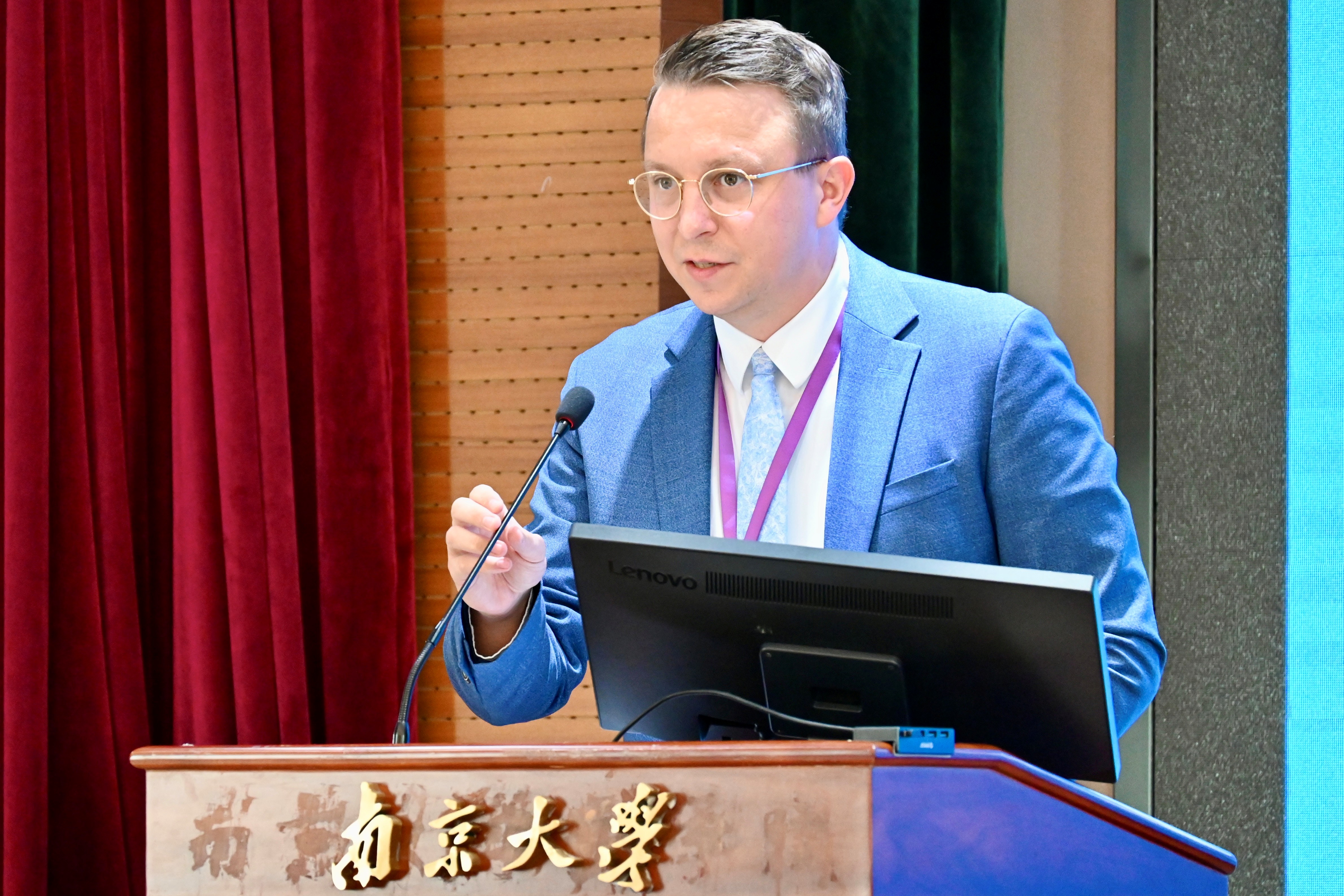

In October 2026, Asst.-Prof. Dr. Markus Schreiber, Chair of Public Law and Blockchain, delivered a guest lecture at the invitation of Prof. Francesca Spigarelli from the University of Macerata (Italy). Together with students from the University of Macerata, he examined one of the greatest challenges of our time: the transformation of the economy and society driven by developments in digitalization and sustainability. Using examples such as precision farming and digital parking guidance systems, he demonstrated how new technologies can be leveraged to use existing resources such as farmland or parking spaces more efficiently. At the same time, he pointed out the negative environmental impacts of digitalization, which are evident, for example, in the high resource and energy demands of data centres or the carbon footprint of online retail.
In addition, Asst.-Prof. Schreiber examined the European Union’s efforts to leverage the opportunities offered by digitalization to achieve climate neutrality by 2050. Among other topics, he discussed the industrial policy of the “Green Deal,” the Common Agricultural Policy, which calls for significant investments in the modernization of agriculture, and the sustainability-related requirements for AI regulation. Overall, it became clear that despite the frequent rhetorical references to the “Twin Transition,” the Green Deal’s requirements ultimately take digitalization into account too rarely, while at the same time sustainability plays hardly any role in AI-related legislation. In conclusion, he presented examples of how Switzerland, as a non-EU country, is addressing the twin transition, using the regulation of artificial intelligence, data centres, and smart grids as case studies.
The guest lecture and the subsequent discussion with the students provided a valuable framework for raising awareness of the interplay between digitalization and sustainability and drawing attention to relevant legal issues. The students were particularly interested in the comparison of the regulatory approaches taken by the European Union and Switzerland.