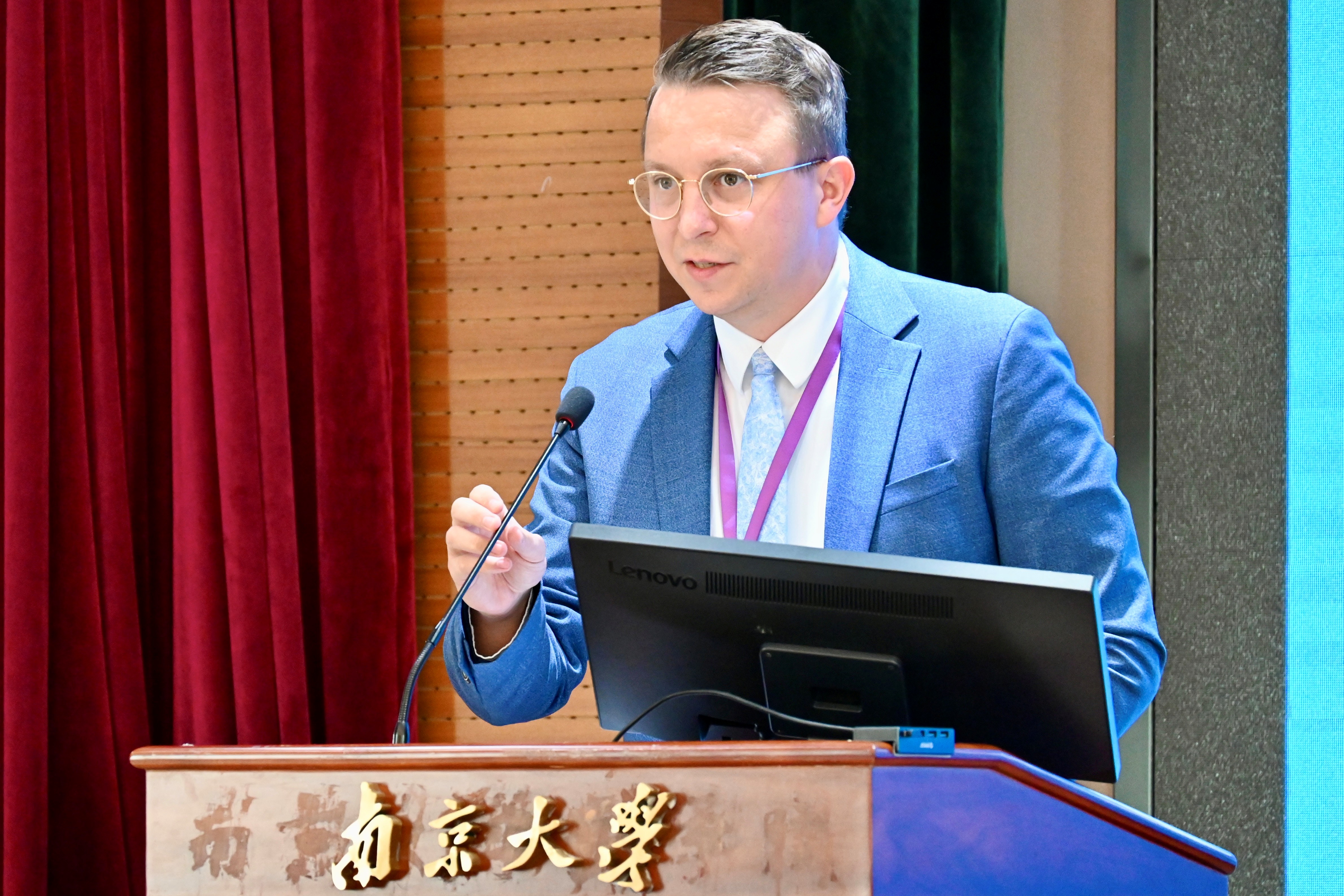
Dr. Ahmed Ajil has been appointed Assistant Professor of Behavioural Sciences with a focus on Criminology and Security Research at the Faculty of Behavioural Sciences and Psychology. He is also affiliated to the ZIBR institute. His project TRACES will explore counterterrorism in Switzerland, Germany and Belgium, and he will develop a research portfolio at the intersection of blockchain research and counterterrorism at the ZIBR institute.
Counterterrorism has become one of the most pervasive, least scrutinised forms of governance in contemporary societies. Over the past two decades it has expanded far beyond airport security and criminal trials into asylum decisions, banking, education, and social work — reshaping who counts as trustworthy, and on what grounds. This is the starting point of TRACES (Terrorism, Race and Embodied Security), Ahmed Ajil's ERC Starting Grant project at the University of Lucerne, which examines counterterrorism as a form of biopower: a diffuse, differential apparatus that sorts populations into categories of risk long before any court gets involved. Across Switzerland, Germany, and Belgium, TRACES examines this apparatus through three lenses — how counterterrorism instruments are applied (criminal law, administrative measures, prevention programmes), how power is deployed through them (via discourse analysis of legal decisions and practitioner interviews), and how it is lived and embodied by those directly and indirectly targeted.
TRACES will be partly hosted by the newly founded ZIBR, and Ahmed Ajil is eager to explore the connections between counterterrorism and blockchain technology. These include, for instance, terrorism financing. In 2025, two individuals were convicted by the Federal Criminal Court in part for financing the so-called "Islamic State", a terrorist organisation, through Bitcoins. Similar cases have been prosecuted in Germany and Belgium. Law enforcement is still grappling with this new technology and trying to find ways to identify payments. At the same time, counterterrorism has also problematically extended to organisations and individuals unrelated to terrorism, but swept into the category of suspects — leading to the freezing of assets, closing of bank accounts, or signalling to authorities, with substantial repercussions on the social, legal and political lives of these individuals. Exploring how counterterrorism deals with certain financial flows differentially, and what role blockchain technology plays therein, will also be of interest to TRACES.
These new possibilities deserve the same critical, empirically grounded scrutiny that TRACES brings to courtroom and administrative decisions: not "is blockchain good or bad for security," but whose money, whose mobility, and whose life gets governed differently because of it.
In any case, the intersection of blockchain technology, counterterrorism, criminology and security studies is a field Ahmed Ajil is eager to explore further with his team, consisting of one PhD student, two part-time postdoctoral researchers and further research assistants.