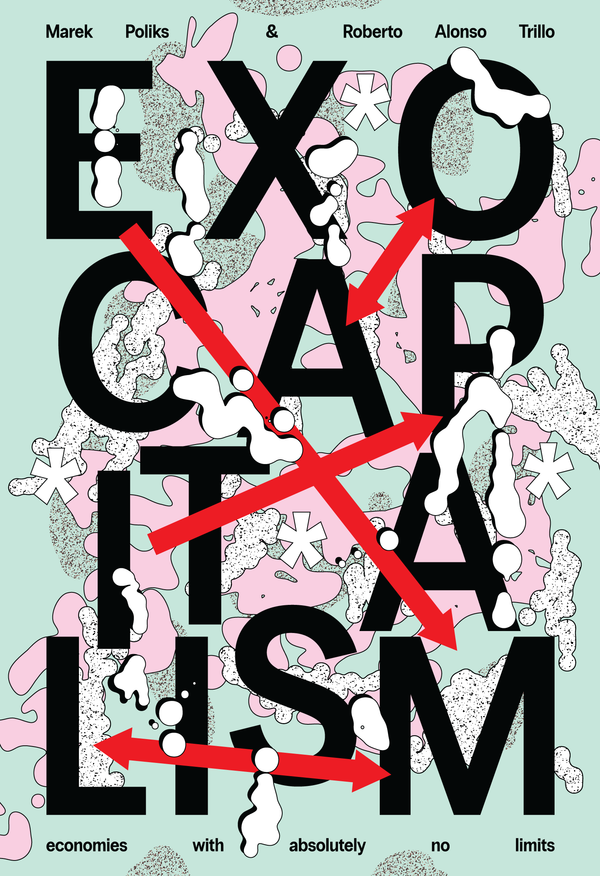
The cosmofinancial framework developed by Poliks and Trillo shows how economic abstractions no longer merely extract value from terrestrial conditions but actively participate in worlding practices, generating, or rather, folding, new planes of speculation, relation, and obligation. One of the book’s core (and polemical) claims is that contemporary capital operates less through labor-time than through the organization of volatility across periods of holding, latency, and friction. Or, as the authors write: “Capitalism has never been and could never be a smooth criminal. It needs the hold, the friction, the instability to generate surplus value." Crypto-financial infrastructures are explicitly designed around the holding of volatility: protocol-level mechanisms such as staking, lockups, governance delays, liquidity provision, and derivative exposure formalize time as an active component of value-production. Volatility here names an infrastructural regime rather than a market signal—a condition in which uncertainty itself is operationalized and sustained through prediction, leverage, and the continuous pricing of futures, extending earlier analyses of derivatives (R. Martin, R. Meister) as social and political technologies.
If you would like to participate in a panel discussion on the relevance of Exocapitalism for blockchain technology and the crypto industry from 16:00–18:00, you can easily get in touch with us via the button.
Hosted by Dr. Andr ea Leiter & Dr. Erik Bordeleau